
Will the Best Netflix Series of All Time Continue?

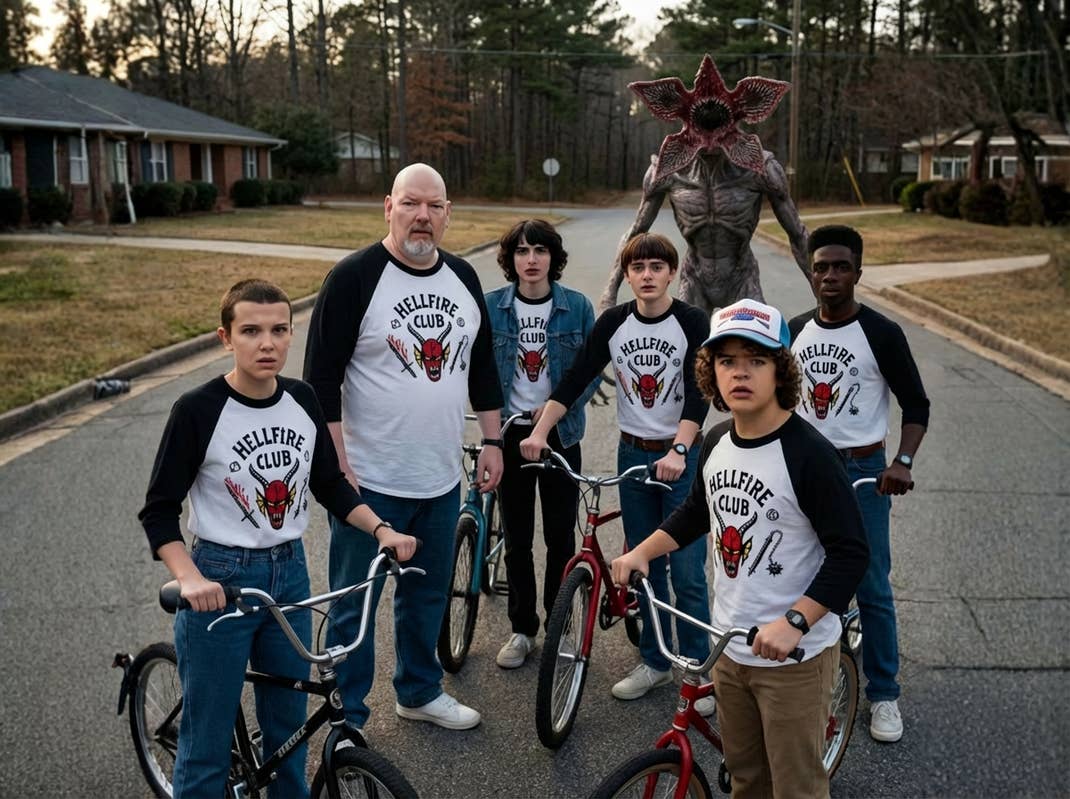
Before we dive any deeper: What actually triggers you more? For me to deem Stranger Things the best Netflix series of all time in the headline? Or for me asking whether it will be continued? Perhaps the article image featuring an adult who is not exactly wiry, playing D&D with the kids?
Regardless of what’s on your mind, there’s no way around it: the story of the kids from Hawkins is over for now, period. Although — perhaps it’s not quite that clear-cut after all.
A quick note before you read on: Spoilers cannot be avoided here. If you haven’t watched the final season of Stranger Things yet, you should stop at this point. Also, if you’re expecting a meticulous analysis of every scene in this two-hour rollercoaster ride, you won’t find it here. I’m more interested in a personal assessment — how the finale and the series as a whole felt for me.
So it is for me alone, not to be compared with millions of media, YouTube videos, or people on social media. That’s why I don’t want to dissect every scene of the final here. For me, it’s about something else: about what Stranger Things meant — and still means — to me.
The Ending is Open-ended, Right?
My feeling after the last episode was very specific: there is an acceptance that even the best stories have to end at some point. At the same time, a sadness lingers because this goodbye felt like losing one’s close friends indefinitely.
But is it really a final farewell? The Duffer brothers — apart from the animated series Tales from ’85) have left a striking number of doors open. Elfi’s story doesn’t end clearly, none of the central characters died, and even the Mindflayer doesn’t seem like a closed chapter. Who actually says that this world devourer was the only one of its kind? Theoretically, the next one could be on its way to good old Earth by now.
The last image in the series also looked like it deliberately pointed in a particular direction: Mike is staring down into the basement at a new generation of kids at the D&D table. This at least hints at a possible starting point for a spin-off focusing on younger characters.
I will be the first to admit: part of me is curious to see if such an approach will eventually develop into something more. At the same time, that’s exactly what worries me. This is because open endings are also an invitation to keep a franchise alive artificially. With the right idea and genuine respect for the original, it can work. But if all you end up with is a lovelessly produced sequel knock-off, that would be nothing more than the cannibalization of a great series.
The 80s Weren’t Just a Setting, It Was an Era
Before I finally work my way through the end of the series, I have something personal to say. My relationship with Stranger Things is inextricably linked to the time in which the series is set. From the very first episode, I didn’t feel like I was watching a series about the 1980s. Rather, it seemed as if it had been brought to us directly from that era.
Of course, the technical realization is different, more modern, more precise. But the way the images were composed and the way the story developed immediately reminded me of my own youth. In the mid-eighties, we had a video recorder. In a television world with three channels and private channels that were just emerging, this device felt like pure magic.
Suddenly, an entire universe of stories opened up: E.T., The Goonies, Stand by Me, John Hughes’ films, Back to the Future — all of these completely captivated me at the time. And that feeling returned when I watched Stranger Things. For a moment, I was sitting in my parents’ living room as a teenager again and let myself be sucked into fantasy worlds.
The Kics’ Story Was Also Part of Mine
Suddenly, I’m transported to being the teenager who grew up with the music at that time. The finale hit me just as hard when Prince started playing “Purple Rain” and David Bowie “Heroes”. All these reminded me that the eighties were not just about neon colors, shoulder pads, and Rubik’s cubes, but — as the series also showed — also about the omnipresent fear of the Cold War, for example.
Another parallel to the series concerns my own role-playing years. Dungeons & Dragons was an integral part of our weekends. We would sit together for hours, Sunday after Sunday, until at some point in the evening the door to our room opened and we were asked how much longer we planned to play.
Of course, we weren’t dealing with real demogorgons or secret research facilities back then. But at its core, the story of the kids from Hawkins still feels familiar to me. The Duffer brothers have reconstructed the 1980s with a love of detail that makes that time tangible for me again. Stranger Things is not a series with a pasted-on 80s look — it carried the decade within it, scene by scene.
Why I Thought It Was a Good Ending
Were there any points I struggled with? Absolutely. This was especially so in the final showdown, where the plot armor was difficult to miss. For long stretches, I had the feeling that our heroes got off surprisingly lightly. The fight itself was well timed, no question. In terms of content, however, it could have been a lot more painful for me. Anyone who takes on an entity that devours entire worlds should have to pay a higher price.
Vecna also seemed less threatening to me than in season 4. As much as I appreciate the backstory surrounding Henry Creel, there is still a bland aftertaste: key details of his past were not told in the series itself, but outsourced to the accompanying play The First Shadow. This felt unnecessarily fragmented.
Nevertheless — and this is crucial — I love this finale. I laughed, I cried, I shared in the excitement. But above all, it’s a finale that took its own promises seriously and consistently fulfilled them.
Promises Kept
Dustin honored Eddie in his Valedictorian speech with D&D references, while Iron Maiden’s “The Trooper” brought Eddie’s story to a worthy, heroic conclusion. Hopper again experienced the supposed loss of Elfi — but this time, he doesn’t break. He made a conscious decision to live. Joyce, on the other hand, faced her pain one last time, defeated Vecna, and thus secured her happy ending with Hopper.
Jonathan saved Steve from a fatal fall from the radio tower, finally ending their rivalry and turning two former adversaries into true friends. And at the end, the story came full circle: Mike watched his little sister Holly play her first round of D&D with her friends. A quiet, conciliatory moment in which friendship, fantasy, and adventure were passed on to the next generation.
It is precisely these fulfilled promises that had a lasting effect. They formed the emotional foundation of the series — and are the main reason why this ending worked for me.
A Really Successful Finale
Apart from that, I was also impressed by the almost two-hour finale. The brief moment in which it seemed as if Will could pull Vecna over to the good side — and even better that the series ultimately decided against it. A strongly acted scene that went in exactly the right direction.
There were plenty of conversations that did not feel like fillers, did not slow down the pace, and still showed real development. A good example was Steve, whose life was saved by Jonathan, of all people. The epilogue made it clear that rivalry can turn into friendship.
Not everyone will like it, but I thought the lengthy epilogue was just right. The series took its time to show how things could continue with the characters. The last scene in the cellar was particularly memorable: The old D&D books went on the shelf, the room emptied — and Will looked back as Holly, Derek, and other kids took their seats.
They took over the baton, flew the Dungeons & Dragons flag, and continued what had always characterized this series. The bottom line for me is this, it was a strong, well-rounded finale — even if not every wish was fulfilled. You mustn’t forget: Millions of people love this series, and millions had their very own idea of the perfect ending. The Duffer brothers couldn’t possibly please everyone.
The Fight After the Fight: My Finale Against the Internet’s Judgment
This brings me to a point that is a little more serious and only indirectly related to Stranger Things. You probably know the feeling: you experience something all by yourself. The finale of a series that you’ve been eagerly awaiting for years. In that moment, you are alone with your emotions, with the characters, with what has just happened. And then the second act begins almost immediately — the battle against the internet.
Suddenly, opinions, analyses, and judgments come flooding in. YouTube is overflowing with deconstructions, social media is boiling over. It feels like half the web is on a veritable scavenger hunt for holes in logic. Two thoughts that I could not shake off are:
- In our attention economy, exaggeration and negativity simply work better. Loud criticism brings more clicks, more comments, more reach than a differentiated or even benevolent classification. A slating is produced faster — and often consumed faster — than praise.
- At the same time, this constant bombardment can undermine your own perception. The endless stream of “The End Explained” videos and articles dissecting supposed mistakes gnaws away at the original feeling. What felt right and coherent immediately after the credits rolled is suddenly called into question. Emotion is replaced by analysis, joy by doubt.
In the end, it all comes down to a conscious decision: do I trust my first, honest feeling — or do I let others talk me out of it? I have chosen the former. This year, I want to make a serious effort not to always look for the fly in the ointment. And I wish we could break out of this maelstrom of negative virality altogether.
Elfi is Alive, I Promise!
The Duffer brothers have deliberately kept the fate of Eleven, aka Elfi, aka Jane, open. Fans should be given room for hope. Either she is actually alive — or she only exists as a kind of emotional anchor for Mike and the others to deal with their supposed victim.
Honestly? For me, this ending only felt open-ended on paper. Clues that showed Elfi survived are too clear for me to be a coincidence. Let me explain why.
- Kali’s ability to create perfect illusions provides the decisive key. A soldier says, “She was just here by the truck.” One moment, Elfi is still sitting next to Mike, she disappears in the next. The obvious explanation: she is not gone at all — we only saw an illusion, maintained by the dying Kali.
- Other details also support this theory. Elfi stretched out her hands, but her tattoo is not visible. We also see a brief, irritating flicker of a hand. It is precisely this visual signal that already debunked Kali’s illusion of herself earlier in the series.
- After Eleven’s supposed sacrifice, the screen briefly goes black — and a quiet, single heartbeat can be heard in the background. You don’t put in a detail like that for no reason. For me, it’s a clear signal: she’s alive.
- There is also an earlier scene in which Mike told Elfi about a fictitious location from an RPG campaign: a peaceful land with three waterfalls. Later, we see Elfi in a similar place — but with only two waterfalls. Perhaps a deliberate indication that she is deliberately retreating to a place where Mike can’t find her.
Elfi had to leave Hawkins so the military would stop hunting her. But that doesn’t necessarily mean she’s dead. For me, one thing is certain: she’s still out there. Somewhere. In the meantime, I’ve also read another point online that I hadn’t even noticed myself: Elfi must have been blindfolded when she dived into her world of thoughts. She did this to say goodbye to Mike — but her eyes weren’t covered.
My Conclusion
Time for a conclusion.
Was that really the final ending? And is Stranger Things really the best series of all time on Netflix? To be honest, we don’t need to answer these questions here. They are ultimately irrelevant — and always have been. Because that was never the point of the series.
For me, the strongest image of the finale was the moment when the group of friends finished their last round of D&D, placed the rulebook back on the shelf, and walked up the stairs together — out into the real world. Quiet, almost unspectacular, and yet incredibly powerful. It stood for the end of childhood and a farewell to one of the most formative phases of life. At the same time, the series came full circle because it ended at the exact point where it began in the very first episode.
Stranger Things was never just a story about monsters and the supernatural. At its core, it was always about growing up in a world that seemed increasingly threatening and complicated. It’s a struggle we all face — regardless of demogorgons, parallel worlds, or armed soldiers.
I am grateful for this almost ten-year journey. Especially in difficult times, the series was perfect escapism and at the same time a kind of time machine back to the 1980s. If you took a closer look, you could learn a lot: about how to tell stories, what values really matter — and above all, about what friendship really means.
I’m now closing this Stranger Things chapter with a pretty good feeling and taking it with me into 2026 afresh as a reminder to allow more positivity, to stick together more often instead of being divisive — and not to take genuine friendships for granted.